Why play A Plague Tale on GeForce NOW Powered by Pentanet?
The A Plague Tale series, especially Requiem, are excellent choices to play on GFN due to the intense CPU requirements created by the teeming hordes of rats, each of which acts independently of the others. When played on Priority with RTX-enabled Requiem is a genuinely breathtaking game and a testament to how far video game graphics have come.
I often wonder why we don’t get more horror (games, movies, whatever) set in the past. After all, these days, we have so many tools at our disposal to scare off the monsters: guns, phones, flashlights, cars, etcetera. Isn’t it so much scarier when the only thing that holds back the dark is a candle? When the merest puff of wind could plunge you into the monster’s world, where chittering hordes are waiting, hungry for their next meal.
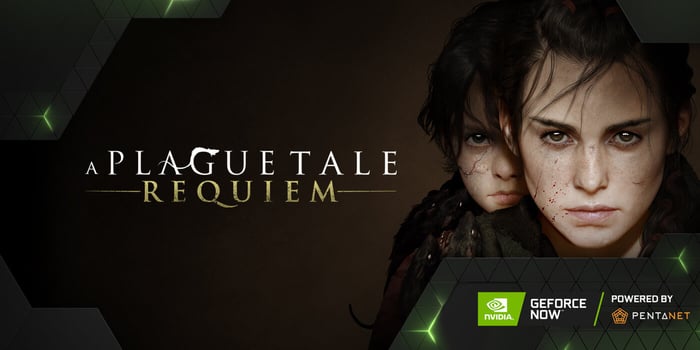
The A Plague Tale series shows us what that kind of horror can be like. Sending us back to a nightmare vision of 14th-century France, it gives very different perspectives on horror and stealth from what we’re used to from games in the modern day.
In most stealth games, the dark is your home, your safe space from enemies in the light. In the A Plague Tale series, you must endlessly walk a terrifying tightrope. Hide in the dark from humanity or hide in the light from the endless waves of rats waiting just beyond its fading reach, eager to devour anyone foolish enough to stray from the light. Either way, you’re never truly safe and can never truly relax.
You use tools such as slings, torches, and flour bags instead of modern devices such as firearms, night vision and grenades. When you master that tightrope tiptoe, you feel unstoppable. Enemies are dancing the same tightrope as you and ripping away their light to feed them to the rats can feel so darkly satisfying. But just as you can make them fall, it’s easy for your pride to see Amicia tumble to her demise.

A sling bullet puts out a lantern as quickly as water, giving the rats their way in.
Both games thrive on this tension, this vulnerability, but in Innocence, the characters feel much more vulnerable than they do in the sequel. Of course, this is due to Amicia’s, well, innocence in the first game. When we meet her, she is a pampered French noble who couldn’t even imagine needing to take a life. Innocence focuses heavily on the death of its title, stripping Hugo and Amicia of the naivety of childhood as they’re forced to confront death, the inquisition, and the plague.
Requiem shows Amicia as a much more jaded warrior, even her young sibling Hugo is less horrified at death (caused by him and otherwise) than he ought to be. Trauma has birthed anger at the world in the pair, and at times Amicia goes from reluctant self-defence to outright aggression, transforming from the hunted into the hunter.
This bloodlust is a crucial narrative point, not just a gameplay shift in introducing more enemies as it may be in another title. Amicia’s increasing aggression is a cause for concern for her and those around her, her friends begging her not to confront issues so violently, to not become a killer, rather than a protector. This comes to a head early on when a borderline psychotic break sees Amicia kill a small army of soldiers before eventually being captured, the inevitable conclusion her friends warned her of in the face of her growing bloodlust.
The focus these games have on the character’s emotions and how the world around them and the horrors they face affect them is one of the greatest strengths of A Plague Tale. These characters feel real, and the emotional impact of their journey hits far harder than your average “John Shooter” in any other action game. We’ve seen them grow from distant, coddled noble youths to survivors, scarred by trauma and violence, but survivors nonetheless. The growth between games is notable but feels natural in the face of what they’ve been forced to endure.
Amicia and Hugo genuinely feel like siblings, like family, especially in Requiem, where their relationship has flourished. The animation is as much a part of this feeling as the voice acting. Amicia will catch her brother when he drops from a ledge, hold his hand as they run, and wrap an arm over him as they sneak through the tall grass. You can feel Amicia’s desire to protect her brother in everything she does. This evolved naturally, too, as she barely knew Hugo at the beginning of Innocence. He had lived his life indoors under her mother’s watchful eye, and Amicia was only aware of him as a presence in the home and why she never got to spend time with her mother. This sibling bond developed naturally over time, through hardship and strife, into a truly unbreakable bond.

Hugo and Amicia are hardly alone in the world either. Requiem gives us a whole cast of very memorable characters to get attached to and mourn over as the story plays out. A particular favourite of mine is Sophia, the scorpion of the Sea, a pirate and smuggler who ran away from a convent as a child. Both villains and protagonists feel alive, and you come to love some and genuinely despise others.
Writing is a clear strength of Requiem, but it’s hardly the only one. The game is stunning, in a way few others can claim, and I would find myself stopping to take in the beautiful or horrifying visuals. It runs the whole gamut as well; once I was stopping to admire the way the setting sun set the ocean aflame in beautiful dancing waves, another I stopped to drink in the horror of the depths of a rat hive, where the game brings eldritchian, alien architecture to the forefront in horrifying vividity. The game is an achievement of the artistry games can achieve, both in terms of writing and visuals.
Bringing those together with top-notch stealth gameplay that feels genuinely unique due to the archaic tools you are forced to rely upon and the tightrope between the light and dark makes for a truly unforgettable gameplay experience. Requiem clocks in at around 15-20 hours, and it feels the perfect length for what it is, telling the story it came to tell and ending before it outstays its welcome.
I hope we see more games set in the world of A Plague Tale, even if they do not follow Amicia and Hugo. There are so many unanswered questions and stories left to tell. The ending certainly left the story open to the idea of more tales in this world, so until then, I’ll be waiting with bated breath, praying the lights don’t go out.
This blog was written by Pentanet team member “Motley” and any opinions expressed here do not represent Pentanet or NVIDIA.